Higan 彼岸 - The Other Shore
May 18, 2026
As the sun’s path transitions us through the fall equinox, it marks a change in the seasons. The passing of time and seasons reminds us of the impermanence of all things. Summer becomes fall, and crops are harvested; leaves abandon their trees, and life slows.
The sun travels in a straight line from East to West during the equinox, pointing the most direct path across the ocean to the other shore. In Japan, this is a time of reflection, a time we remember our ancestors— those that have crossed to the other shore before us.
The three days before and after the equinox is the season of Higan 彼岸 at Zen temples across Japan. Priests and practitioners perform ceremonies for the departed spirits of ancestors. During this time, people visit family temples and graves, often travelling great distances. March and September are national holidays, which makes the journey possible.
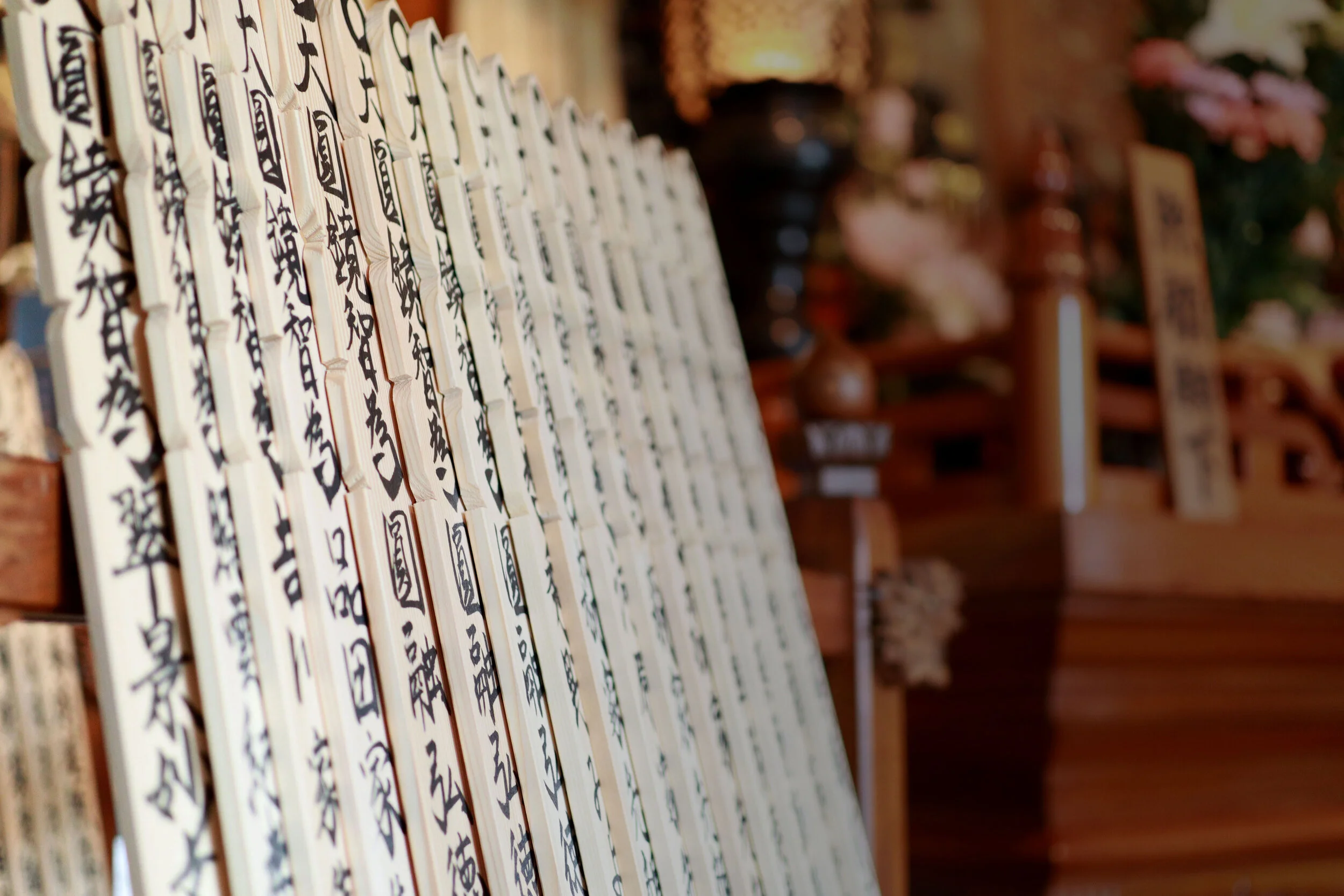
Toba (塔婆)
I was fortunate to have the opportunity to help during this busy time at Tokozenji Temple in Yokohama and experience it in a special way. A temple community is a special kind of family, one connected by compassion and caring. I was tasked with arranging the Toba (塔婆), which represents the body of the deceased. The shapes of the Toba signify the five elements of earth (square), water (circle), fire (triangle), wind (semi-circle), and space. The top of the Toba is the level representing space (空), shaped like a jewel to signify the “treasure of fulfilment.” The careful writing of the names showed that the preparations had been happening many days before.
As people arrived, they greeted each other as old friends and sat together for the service. Daigo Ozawa led them through a beautiful Dharma talk, which brought everyone even closer to share in the memory of those who have gone before. As is truly the meaning of Higan, the story seemed to bring us closer to the other shore. Everyone then chanted the Heart Sutra (般若心経) and offered their prayers with incense.
Ozawa San spread the smoke from the incense of everyone’s combined prayers across all the Toba. To me, it was as if everyone was sending wishes and gratitude to all ancestors, not just their own, as a symbol of our interconnectedness.
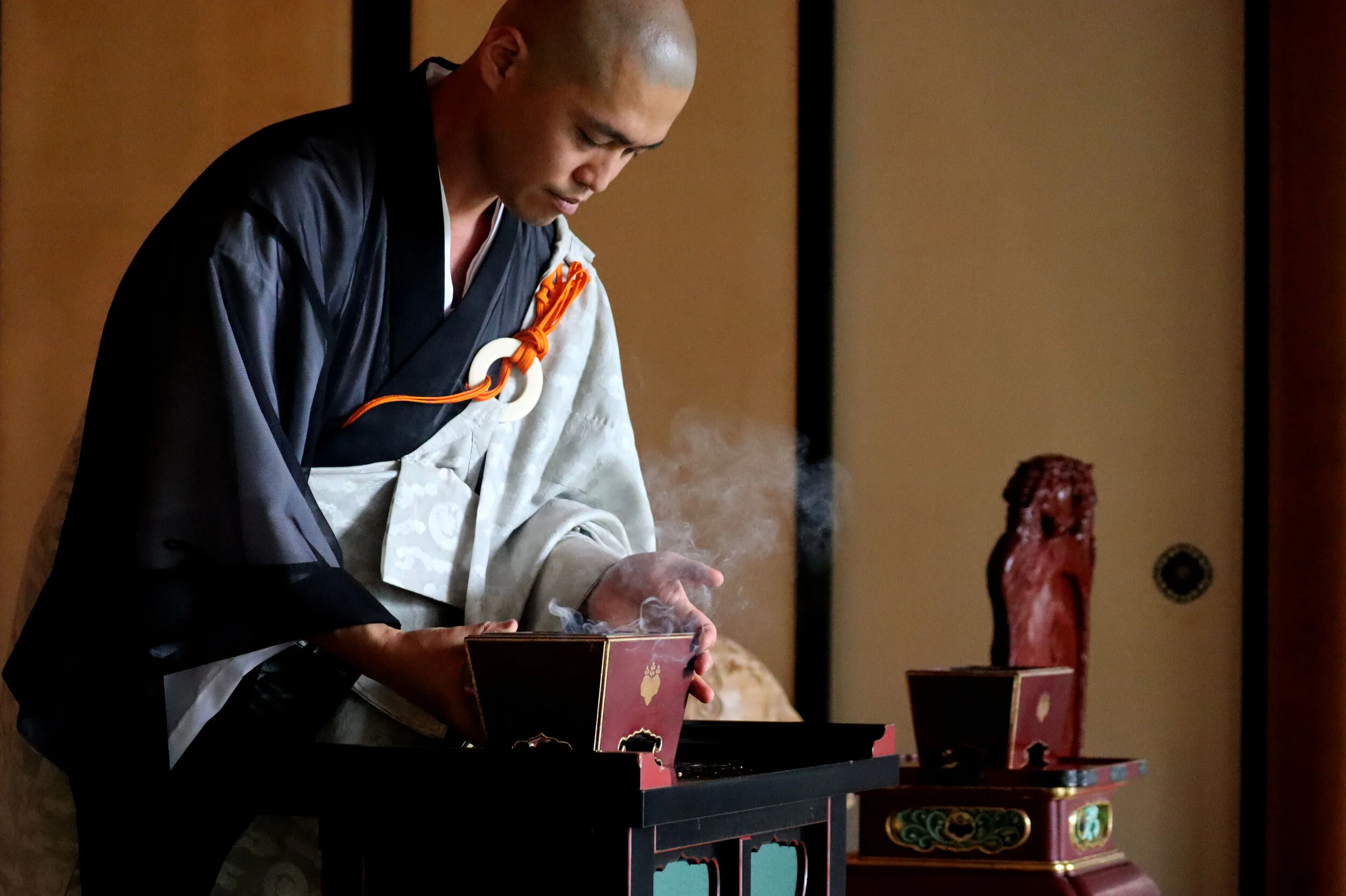
Daigo Ozawa (小澤 大吾), Jushoku (白山 東光禅寺 住職)
After the service, family members visited the graves, sweeping them and pouring water over the headstones. Then arranged thoughtfully are flowers, incense and favourite foods of loved ones who have passed away. It is a time to pause the hectic pace of daily life and reflect with an appreciation of the life given to us through those that have gone to the other shore.
There are six items taken when visiting the family gravesite during Higan, and they reflect the Six Paramitas:
-
Water is the giver of life; without it, all living things perish, and so it causes us to reflect on giving—the Paramita of Generosity, 布施 (fuse).
-
Powdered incense perfumes the body and refreshes the mind, as does keeping the precepts—the Paramita of Morality, 持戒 (jikai).
-
Flowers calm the mind, diffuse anger and remind us of restraint—the Paramita of Patience, 忍辱 (nin-niku).
-
Stick incense burns with a constant stream of fragrance with such effort as to give itself entirely to its purpose—the Paramita of Diligence, 精進 (shojin).
-
Food and drink satisfy us so that we might turn to contemplation—the Paramita of Meditation, 禅定 (zenjo).
-
Light illuminates darkness as wisdom does ignorance, showing us the way—Wisdom, 般若 (chie).
The metaphor of “the other shore” might lead us to imagine it as a destination or a place we arrive at or even someplace we go after death. The word Higan comes from the Sanskrit word Paramita, which translates as ‘having reached the other shore.’ It also means ‘transcendence’ or ‘perfection.’ If our existence is on the shore of suffering, to reach the other shore would mean to leave behind suffering or to become enlightened. In this way, transcendence means to become free from the mental afflictions which cause our suffering and, therefore, to be freed from suffering itself.
In Zen, we travel from this shore to the other by practising the Six Paramitas, living to ourselves and others’ mutual benefit.
When we practice, we don’t go to the other shore; the other shore arrives within us. Higan reminds us to practice with gratitude for those who have gone before and to abandon self-cherishing for the sake of all beings.
Lorem ipsum dolor sit amet, consectetur adipiscing elit. Cras sed sapien quam. Sed dapibus est id enim facilisis, at posuere turpis adipiscing. Quisque sit amet dui dui.
Stay connected with news and updates!
Join our mailing list to receive the latest news and updates from our team.
Don't worry, your information will not be shared.
We hate SPAM. We will never sell your information, for any reason.